
The 1980 murder of Betty Gore shocked the small community of Wylie, Texas, and decades later, the case continues to captivate audiences through HBO’s Love & Death and Hulu’s Candy series.
At the center of this tragic story is Allan Gore, Betty’s husband, whose life changed forever on June 13, 1980. While much attention focuses on Candy Montgomery and the brutal murder trial, many wonder: where is Allan Gore now, and how has he rebuilt his life after such unimaginable loss?
Allan Gore today lives a quiet, private life in Sarasota, Florida, far removed from the media spotlight that continues to follow the case. More than 45 years later, the teacher-turned-engineer maintains strict privacy about his current life, his domestic partnership since 2016, and his reconciliation with his two daughters, Alisa and Bethany.
This article explores Allan Gore’s life after the murder trial, his journey through grief and estrangement, and what happened to Betty Gore’s husband in the decades since that fateful day.
Table of Contents
Who Is Allan Gore? Quick Background
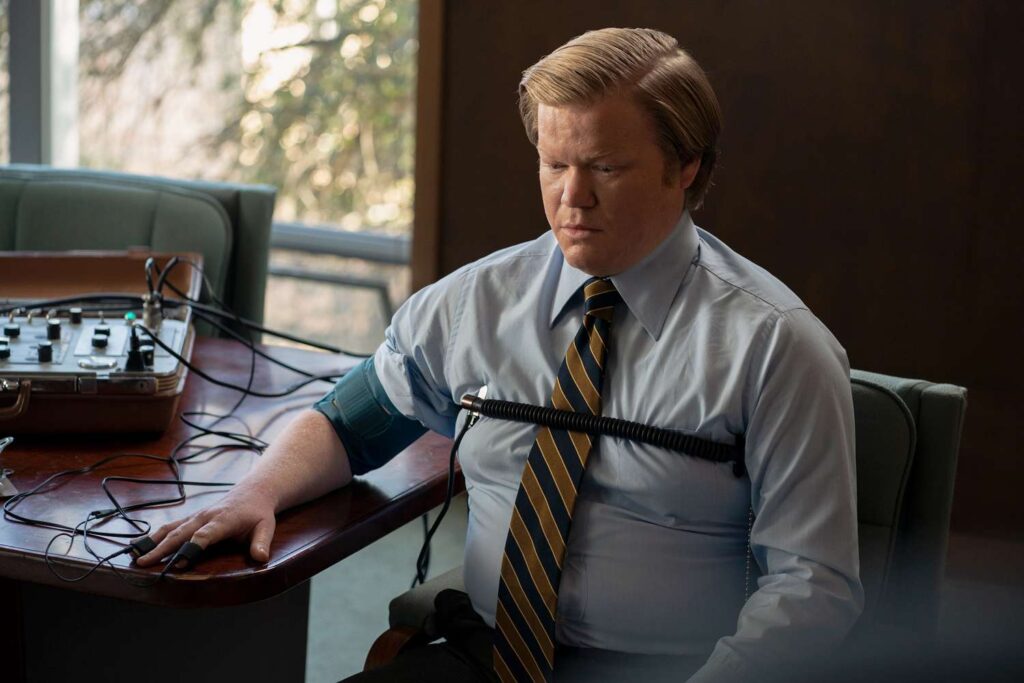
Allan Gore was an ordinary man living an ordinary life in Collin County, Texas, until June 13, 1980, when he returned from a business trip to Minnesota to discover his wife Betty Gore had been murdered in their home. The brutal murder—Betty was struck 41 times with an axe—sent shockwaves through the tight-knit community of Wylie, Texas, and the subsequent trial became one of the most sensational cases in Texas history.
What made this crime scene even more shocking was the identity of the killer: Candy Montgomery, a close friend from the Methodist Church of Lucas and Allan Gore’s former lover. The extramarital affair between Allan and Candy, which lasted from December 1978 to October 1979, became central to understanding the events that led to Betty’s death in the utility room of the Gore family home.
The case has experienced renewed interest thanks to two major television adaptations. HBO Max’s Love & Death, starring Jesse Plemons as Allan Gore and Elizabeth Olsen as Candy Montgomery, premiered in 2023, followed closely by Hulu’s Candy series. These true crime dramatizations brought the story to a new generation, prompting viewers to search for information about the real people behind the characters, particularly Allan Gore’s current life.
People are searching for Allan Gore Love and Death content because the series sparked curiosity about what happened to Allan Gore after the trial. Unlike other figures in true crime cases who write books or give interviews, Allan has maintained complete silence about the case for over four decades, making him an enigmatic figure in this tragic story.
The HBO series portrays Allan as a devoted but emotionally distant husband whose business trip inadvertently left Betty vulnerable on the day of her death. Jesse Plemons’s performance captures Allan’s quiet demeanor and the complicated grief of a man who lost his wife to his former mistress. The show’s accuracy regarding Allan’s role has been debated, but it has undeniably reignited public interest in the question: where is Allan Gore living now?
Where Is Allan Gore Living Now?
Allan Gore today resides in Sarasota, Florida, where he has built a new life far from the memories of Wylie, Texas, and the 1980 murder that defined his past. After leaving Texas in the early 1980s, Allan eventually settled in the Gulf Coast city, choosing a location known for its retirement communities and peaceful lifestyle—a stark contrast to the media frenzy and public scrutiny he experienced during and after the murder trial.
According to public records and limited reporting, Allan Gore’s current residence in Sarasota has been his home for several years. The coastal Florida city, located south of Tampa Bay, offers the privacy and anonymity that Allan has fiercely protected since the trial concluded in October 1980. Unlike Wylie or other areas of the Dallas-Fort Worth metroplex where the case remains well-known, Sarasota provided Allan with the opportunity to live without constant reminders of the tragedy.
Since 2016, Allan has been in a domestic partnership, though he has kept details about his partner and relationship completely private. This domestic partner represents Allan’s attempt to find companionship and normalcy after decades of navigating life after the murder. Public records indicate the relationship has remained stable, suggesting Allan has finally found some measure of peace in his personal life.
Allan Gore Sarasota Florida life is characterized by retirement and privacy. Now in his mid-70s, Allan has long since left his career as a systems engineer and teacher behind. Those who have encountered him in Florida describe a man who keeps to himself, avoids social media entirely, and has no interest in discussing the past. He does not attend community events where he might be recognized, and he has never participated in any media coverage about the case.
The choice to settle in Sarasota was likely strategic. Florida’s large population and transient nature make it easier for someone seeking anonymity to blend in. Unlike smaller Texas communities where everyone knew everyone, Sarasota offered Allan the chance to be just another retiree enjoying the sunshine and coastal lifestyle. The distance from Texas—over 1,000 miles—also provided geographical separation from the places and people connected to Betty’s death.
What happened to Allan Gore in terms of his daily life remains largely unknown. He does not maintain public social media profiles, has unlisted contact information, and has successfully avoided being photographed or interviewed about the case. This level of privacy is remarkable given the continued public interest in the case, particularly following the release of Love & Death and Candy series.
Allan’s retired life in Florida contrasts sharply with the public visibility of Candy Montgomery, who changed her name and moved to Georgia. While Candy’s whereabouts and activities have been tracked by true crime enthusiasts and journalists, Allan has managed to maintain a veil of privacy that few people connected to famous cases achieve.
Allan Gore’s Marriage to Betty Gore
Allan Gore and Betty Gore’s relationship began in an unlikely setting—Allan was Betty’s teacher. The two met when Betty Pomeroy was his student, and despite the unconventional beginning, they fell in love and married in January 1970. Betty, who came from a religious family in Kansas, was drawn to Allan’s intelligence and steady nature. At the time, such teacher-student relationships that continued after graduation were not as scrutinized as they would be today.
The couple settled into married life in Wylie, Texas, a small town northeast of Dallas that was experiencing growth as a suburb of the expanding Dallas-Fort Worth metroplex. Allan worked as a teacher initially before transitioning into systems engineering, while Betty embraced her role as a homemaker and mother. They became active members of the Methodist Church of Lucas, a congregation that would later play a pivotal role in the tragedy that ended their marriage.
Allan and Betty had two daughters: Alisa Gore, born in the early 1970s, and Bethany Gore, born in 1979, just a year before Betty’s murder. By all outward appearances, the Gores were a typical suburban family—church-going, community-oriented, and focused on raising their children in a safe, wholesome environment. Their home in Wylie became the center of their family life, though beneath the surface, cracks in their marriage were beginning to show.
Life in Wylie, Texas, during the late 1970s was characterized by rapid suburban growth, strong community ties, and conservative values. The Methodist Church of Lucas served as the social hub for families like the Gores and the Montgomerys, providing not just spiritual guidance but also community activities, support groups, and social events. It was at one of these church functions in 1978 that Allan Gore first connected with Candy Montgomery in a way that would prove fatal.
Betty Gore was known in the community as a devoted mother, though some described her as having struggled with depression and anxiety. She was meticulous about her home, particular about routines, and deeply invested in her daughters’ lives. Friends later testified that Betty could be difficult and demanding, though these characterizations emerged primarily during the trial as the defense worked to explain why Candy Montgomery might have felt threatened during their confrontation.
Allan, by contrast, was described as reserved, intellectual, and emotionally distant. He was devoted to his work and family in practical ways—providing financially, maintaining the household, participating in church activities—but he struggled with emotional intimacy. This emotional distance in the marriage would later be cited as one factor that led Allan to seek connection elsewhere, specifically with Candy Montgomery.
The marriage produced two daughters who were Allan’s pride and joy. Alisa, the older daughter, was in elementary school at the time of her mother’s death, while Bethany was just an infant. Allan’s relationship with his daughters would become one of the most painful aspects of the aftermath, as custody battles and estrangement followed the trial.
By late 1978, the Gore marriage was experiencing difficulties. Betty’s parents, Bob and Bertha Pomeroy, later acknowledged that their daughter had confided that Allan seemed distant and distracted. Allan, for his part, felt unfulfilled and was seeking something his marriage couldn’t provide. These marital struggles set the stage for the affair with Candy Montgomery that would have devastating consequences.
The Affair With Candy Montgomery
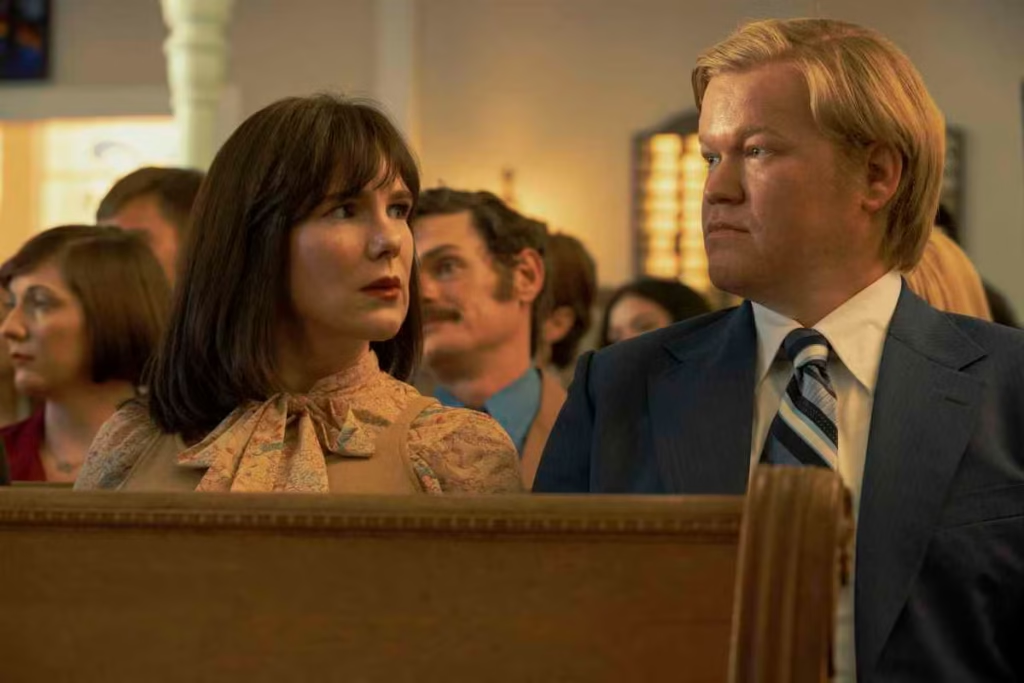
Allan Gore and Candy Montgomery met at the Methodist Church of Lucas in 1978, where both families were active members. Candy, married to Pat Montgomery, was known for her vivacious personality, organizational skills, and involvement in church activities. She was everything Betty was not—outgoing, spontaneous, and emotionally expressive. The attraction between Allan and Candy developed during church volleyball games and social events, where their chemistry became increasingly obvious to both of them.
The affair began in December 1978 when Allan and Candy, both in their early 30s, decided to pursue a physical relationship. They established strict rules for their extramarital affair: it would be purely physical, with no emotional attachment; they would meet only during designated times; and they would end it immediately if either spouse discovered the relationship or if either of them developed deeper feelings. These rules were meant to protect their respective marriages and families while allowing them to fulfill needs they felt were unmet at home.
The affair timeline ran from December 1978 to October 1979, lasting approximately ten months. Allan and Candy met at various locations, including motels in Plano, Texas, and McKinney, Texas, carefully scheduling their encounters to avoid detection. They maintained their friendship in public settings at church and community events, with no one suspecting the intimate relationship they were conducting in secret.
During this period, both Allan and Betty Gore, as well as Pat Montgomery and Candy, continued their lives as usual. The Montgomerys and Gores socialized together, their children played together, and they attended church services side by side. The duplicity required to maintain this double life was significant, and the strain began to show on both Allan and Candy, though they managed to keep their secret from their spouses and friends.
Allan ended the relationship in October 1979, approximately eight months before Betty’s murder. According to testimony at the trial, Allan decided to terminate the affair because he felt guilty about betraying Betty and wanted to work on his marriage. Candy, who had also grown concerned about the risks of discovery, agreed to end the physical relationship, though they continued to see each other regularly at church and community functions.
The decision to end the affair was complicated by the fact that their families remained interconnected through the Methodist Church of Lucas. Allan and Candy couldn’t simply avoid each other—they had to continue interacting as friends and church members, pretending that nothing had ever happened between them. This awkward dynamic continued for the next eight months, until June 13, 1980.
What neither Allan nor Candy apparently anticipated was how the affair would continue to impact their lives even after it ended. Betty Gore would later discover evidence of the relationship, leading to a confrontation with Candy Montgomery that would end in Betty’s death. The affair, which both Allan and Candy thought they had successfully concluded and hidden, became the central element of the murder trial and the primary explanation for why Candy was in the Gore home on that fateful day.
The affair demonstrates the dangerous intersection of unmet needs, poor judgment, and the complex dynamics of suburban life in the late 1970s. Allan’s decision to pursue a relationship with Candy, while keeping his marriage to Betty intact, ultimately contributed to a chain of events that destroyed multiple families and left two daughters without a mother.
The Day Betty Gore Was Murdered
June 13, 1980, began as an ordinary Friday for the Gore family, but it would end with one of the most brutal murders in Texas history. Allan Gore was away on a business trip to Minnesota, leaving Betty at home with their two daughters, Alisa and infant Bethany. Allan’s absence that day would become a source of profound guilt and what-if scenarios that haunted him for years afterward.
Betty’s routine that morning involved caring for Bethany and preparing for an ordinary day. Alisa was spending the night at the Montgomery home, which was a regular occurrence given the families’ friendship. This seemingly innocent sleepover arrangement meant that Candy Montgomery had a legitimate reason to visit the Gore home—she needed to retrieve a swimsuit for Alisa, who wanted to go swimming with the other Montgomery children.
Candy arrived at the Gore residence around midday, entering through the back door as was customary among friends in the community. What happened next remains partially unclear, but based on Candy’s testimony during the trial, Betty confronted Candy about the affair with Allan. Betty had discovered evidence of the relationship—exactly what evidence remains disputed—and she demanded to know if Candy had slept with her husband.
According to Candy’s account, she admitted the affair but explained it had ended months earlier. Betty’s reaction was reportedly intense and emotional. The confrontation escalated from words to physical violence when Betty retrieved an axe from the utility room. What followed was a horrific struggle that resulted in Betty being struck 41 times with the axe, leaving the crime scene covered in blood and the utility room in complete disarray.
Meanwhile, Allan Gore was conducting his business trip in Minnesota, completely unaware of the tragedy unfolding at home. He had left Texas expecting to return to his normal life, with his wife caring for their children and his secret affair safely in the past. The business trip to Minnesota, which should have been routine, instead created the circumstances that left Betty vulnerable and alone.
When Allan couldn’t reach Betty by phone later that day, he grew concerned. His calls went unanswered, which was unusual given that Betty was meticulous about communication, especially when he was traveling. By evening, Allan’s concern had escalated to alarm. He contacted neighbors and asked them to check on Betty, but what they discovered at the Gore home was beyond anyone’s worst nightmare.
The discovery of Betty’s body in the utility room, covered with a sheet but surrounded by evidence of the violent attack, sent shockwaves through Wylie, Texas. Betty had been struck 41 times in a frenzy of violence that suggested extreme rage or fear. The axe murder weapon was found at the scene, and the brutality of the crime led investigators to initially suspect a random intruder or robbery gone wrong.
Allan’s phone call to Candy Montgomery came shortly after he learned of Betty’s death. This call would later become crucial evidence at the trial. Allan, in shock and desperate for information, asked Candy if she had seen Betty that day. Candy admitted she had visited the Gore home to retrieve the swimsuit but claimed everything had been fine when she left. This conversation, which occurred before Candy became a suspect, would later be scrutinized as evidence of both Allan’s innocence and Candy’s initial deception.
The day Betty Gore was murdered changed Allan’s life forever. He lost his wife, his daughters lost their mother, and the community lost its sense of safety. The fact that Allan was away on a business trip meant he had an ironclad alibi, but it also meant he would forever carry the guilt of not being there to protect Betty, regardless of whether his presence could have prevented the tragedy.
Allan Gore’s Testimony at Candy’s Trial
In October 1980, four months after Betty’s murder, Allan Gore took the stand at Candy Montgomery’s trial to testify about his relationship with the accused and the events surrounding his wife’s death. His testimony was among the most anticipated moments of the trial, as the public and jury wanted to hear directly from the man at the center of the case—Betty Gore’s husband and Candy Montgomery’s former lover.
Allan’s appearance in court revealed a man devastated by grief and clearly uncomfortable with the public scrutiny. What he revealed in court during his testimony became headline news across Texas and beyond. Allan confirmed the affair with Candy Montgomery, detailing how it began at church, the rules they established for the relationship, and his decision to end it in October 1979.
The details about the affair that Allan provided were crucial to Candy’s defense strategy. Her legal team argued that Betty had confronted Candy about the affair, triggering a violent altercation that led to Candy acting in self-defense. Allan’s testimony confirmed that such a confrontation was plausible—Betty had indeed discovered evidence of the affair, and her emotional state in the months before her death had been fragile.
Allan described his marriage to Betty with painful honesty, acknowledging the emotional distance that had developed between them and his reasons for seeking connection with Candy. He testified about Betty’s discovery of the affair, which occurred shortly before her death, and her emotional reaction to learning about his betrayal. This testimony helped establish the prosecution’s theory that Betty’s anger over the affair provided motive for a confrontation with Candy.
During cross-examination, the defense attorneys pressed Allan about Betty’s mental state and whether she had ever been violent or threatening. Allan’s responses were measured but suggested that Betty, while not typically violent, had been deeply upset about the affair and had confronted him emotionally when she discovered it. This testimony supported Candy’s claim that Betty had initiated physical violence during their confrontation.
The not guilty verdict that resulted from the trial shocked many observers, but it was based largely on Candy’s claim of self-defense and the testimony supporting the theory that Betty had attacked first with the axe. Allan’s testimony, while not explicitly supporting Candy’s acquittal, provided context that made her self-defense claim more believable to the jury. The fact that Betty had recently discovered the affair and was emotionally distraught gave credence to the idea that she might have become violent during a confrontation.
Allan’s demeanor during testimony was described by court observers as devastated and guilt-ridden. He answered questions directly but showed visible pain when discussing Betty and the affair. His testimony lasted several hours, during which he was forced to relive the worst moments of his life in front of a packed courtroom and intense media coverage.
The murder trial in October 1980 became a media sensation, with reporters from across the country covering the case. Allan’s role as both victim’s spouse and catalyst for the events leading to the murder made him a figure of both sympathy and criticism. Some community members blamed Allan for Betty’s death, arguing that his affair had set in motion the chain of events that led to the confrontation. Others sympathized with him as a grieving husband who had made a terrible mistake.
Candy’s acquittal at the end of the trial meant that Allan had to live with the knowledge that his wife’s killer would face no punishment. The jury’s decision, based on the self-defense claim, left Allan without the closure that a guilty verdict might have provided. The trial’s conclusion marked the beginning of a new, difficult chapter in Allan’s life—one in which he would have to rebuild while processing both grief and the public’s judgment of his role in the tragedy.
Allan’s Life Immediately After the Trial
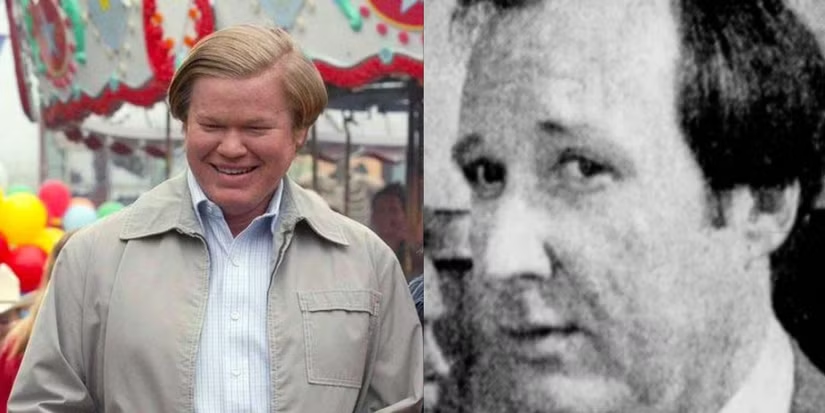
The period following Candy Montgomery’s acquittal in October 1980 was tumultuous for Allan Gore. With the trial concluded and Candy walking free, Allan faced the daunting task of rebuilding his life while managing the grief, guilt, and public scrutiny that came with the case’s notoriety. The decisions he made during this time would have lasting consequences for his relationships with his daughters and his place in the community.
In a move that surprised and scandalized many in Wylie, Texas, Allan Gore remarried quickly after the trial. He wed a woman he had apparently been seeing during the trial proceedings, though the exact timeline remains somewhat unclear. This quick remarriage, occurring within months of Betty’s death, was viewed by some as evidence that Allan had moved on too quickly, while others saw it as a desperate attempt to provide stability for his daughters and himself.
The most painful consequence of this period was Allan’s loss of custody of his daughters, Alisa and Bethany. Betty’s parents, Bob and Bertha Pomeroy, filed for custody of their granddaughters, arguing that Allan’s affair had contributed to their daughter’s death and that he was not fit to raise the girls. The custody battle was fierce and deeply personal, with both sides presenting arguments about what was best for the children.
The court ultimately awarded custody to Bob and Bertha Pomeroy, leaving Allan with limited visitation rights. The daughters were raised by Betty’s parents in Kansas, far from their father and the memories of Wylie, Texas. This arrangement meant that Alisa and Bethany grew up hearing their grandmother’s version of events, which cast Allan in a less-than-favorable light given his role in the affair that preceded their mother’s death.
Allan’s move away from Wylie, Texas, came shortly after losing custody of his daughters. The small community, which had once been his home and the center of his social life, had become a place of painful memories and judgment. Everywhere Allan went in Wylie—the Methodist Church of Lucas, the grocery store, the schools—he encountered people who knew about the case and had opinions about his role in the tragedy.
The estrangement from his daughters would last for years, becoming one of the most painful aspects of Allan Gore’s life after the trial. Alisa and Bethany grew up largely without their father, their relationship damaged by distance, their grandparents’ influence, and the complicated circumstances of their mother’s death. Allan’s attempts to maintain a relationship with his daughters during their childhood were frustrated by the custody arrangement and the Pomeroys’ understandable protectiveness.
Allan’s second marriage, which had begun with such promise as a fresh start, also proved troubled. The relationship was strained by the circumstances of its beginning, Allan’s emotional state, and the continued fallout from the case. Within a few years, this marriage also ended in divorce, leaving Allan alone again and facing another period of rebuilding.
During this time, Allan also had to navigate his career. His work as a systems engineer had provided stability and purpose, but the notoriety of the case made it difficult to maintain privacy at work. Colleagues knew about his connection to the famous trial, and Allan had to decide whether to stay in Texas, where the case was well-known, or relocate to somewhere he could start fresh without the weight of the past following him everywhere.
The immediate aftermath of the trial was characterized by loss for Allan Gore—loss of his daughters, loss of his community, loss of his privacy, and loss of any sense of normalcy in his daily life. These losses, compounded by the grief of losing Betty and the guilt over his role in the events leading to her death, created a perfect storm of emotional and practical challenges that would take Allan years to navigate.
What Happened to Allan Gore’s Daughters?
Alisa Gore and Bethany Gore, the two daughters of Allan and Betty Gore, were raised by their maternal grandparents, Bob and Bertha Pomeroy, in the aftermath of their mother’s brutal murder. This arrangement, which resulted from the custody battle that followed the trial, meant the girls grew up in Kansas rather than Texas, with their father largely absent from their daily lives during their formative years.
Being raised by Bob and Bertha Pomeroy provided the girls with stability and love during an impossibly difficult time. The Pomeroys, who had lost their daughter in the most tragic circumstances imaginable, poured their energy into raising Alisa and Bethany, ensuring the girls had a normal childhood despite the extraordinary circumstances of their early years. The grandparents shielded the girls from media attention and tried to provide them with as much normalcy as possible.
However, the arrangement also meant that Alisa and Bethany experienced estrangement from their father for many years. Allan’s limited visitation rights and the geographical distance between Texas (where he eventually settled in various locations) and Kansas made regular contact difficult. The girls heard their grandmother Bertha’s perspective on their mother’s death and their father’s role in the affair that preceded it, which inevitably shaped their understanding of their family history.
The estrangement from Allan lasted through much of Alisa and Bethany’s childhood and adolescence. During these years, Allan missed countless milestones—first days of school, graduations, birthdays, and the everyday moments that define a parent-child relationship. This absence, while legally imposed and circumstantially necessary, created a gulf between Allan and his daughters that would take years to bridge.
As Alisa and Bethany grew into adulthood, however, a gradual reconciliation began to take place. The girls, now mature enough to understand the complexities of the situation and form their own judgments, started to reconnect with their father. This reconciliation process was slow and delicate, requiring all parties to navigate decades of hurt, misunderstanding, and lost time.
The eventual reconciliation between Allan and his daughters represents one of the few positive developments in this tragic story. Both Alisa and Bethany, now adults with careers and families of their own, have reestablished relationships with their father. While the relationship may never fully recover the years that were lost, the fact that reconciliation occurred suggests that the daughters chose forgiveness and connection over continued estrangement.
Their lives now reflect normal, productive adulthoods. Both daughters pursued education and established careers, married, and started families of their own. They have chosen to maintain privacy about their personal lives, avoiding media interviews and public discussion of their mother’s murder. This privacy is understandable given the continued public interest in the case, particularly following the release of the Love & Death and Candy series.
Alisa and Bethany’s decision to maintain privacy extends to social media as well. Neither daughter maintains public social media profiles that reference their connection to the case, and they have successfully avoided being drawn into the public conversation about the HBO and Hulu dramatizations. This privacy allows them to live their lives without constant reminders of their mother’s death and the circumstances surrounding it.
The loss of their mother at such young ages—Alisa was in elementary school and Bethany was just an infant—meant that neither daughter has many memories of Betty Gore. What they know about their mother comes from family stories, photographs, and the accounts of those who knew Betty. This loss of direct memories makes their mother’s death even more poignant, as they grieve not just for what they lost but for the relationship they never had the chance to fully develop.
The daughters’ story is a reminder of the long-lasting impact of the tragedy. While the trial ended in 1980 and the main figures in the case moved on with their lives, Alisa and Bethany continued to live with the consequences every day. They grew up without a mother, were separated from their father, and carried the burden of being connected to one of the most famous murder cases in Texas history.
Allan Gore’s Second Marriage and Divorce
Following the trial in October 1980, Allan Gore’s quick remarriage during the trial proceedings became a source of controversy and speculation. The woman Allan married has remained largely anonymous in media coverage, with few details available about her identity, how they met, or the circumstances that led to their relationship. This marriage, which began in the shadow of Betty’s murder and the sensational trial, faced extraordinary challenges from the outset.
The brief marriage details that are publicly available suggest that this relationship was complicated by the timing and circumstances of its beginning. Allan was still processing grief over Betty’s death, guilt over his affair with Candy Montgomery, and the trauma of testifying at the murder trial. These emotional burdens, combined with the public scrutiny that came with his notoriety, created an unstable foundation for a new relationship.
Allan’s second wife also had to navigate the difficult reality of being married to a man whose life was defined by tragedy and scandal. She faced judgment from community members who viewed Allan’s quick remarriage as inappropriate or evidence of shallow feelings for Betty. The relationship struggled under the weight of these external pressures as well as the internal challenges of Allan’s emotional state.
The divorce timeline suggests the marriage lasted only a few years before ending in divorce. The exact reasons for the divorce have not been made public, and both Allan and his second wife have maintained privacy about the relationship and its dissolution. However, the timing suggests that the marriage could not withstand the combined pressures of Allan’s past, the ongoing fallout from the case, and whatever personal incompatibilities existed between the couple.
After this divorce, Allan remained single for many years before eventually entering into his current domestic partnership in 2016. The decades between his second divorce and his current relationship suggest that Allan took significant time to heal, process his experiences, and prepare himself for another attempt at companionship. This period of being single may have been necessary for Allan to achieve the emotional stability required for a healthy relationship.
Allan’s current domestic partnership, which began in 2016, represents a more stable and private relationship than his previous marriages. The fact that Allan chose a domestic partnership rather than marriage may reflect lessons learned from his previous experiences or simply a preference for a less formal arrangement. Regardless of the legal structure, this relationship has endured for several years, suggesting that Allan has finally found the stability and companionship that eluded him in the decades following Betty’s death.
The domestic partner’s identity has been kept completely private, with no information available about who this person is, how they met Allan, or whether they knew about his past when the relationship began. This level of privacy is consistent with Allan’s approach to his life in Sarasota, Florida, where he has successfully avoided public attention and media scrutiny.
The progression from quick remarriage during the trial to divorce to decades of being single to a stable domestic partnership reflects Allan Gore’s journey toward healing and stability. Each relationship and period of his life after Betty’s death represented a different stage in his process of coping with tragedy, guilt, and the challenge of building a new life in the aftermath of such devastating events.
Does Allan Gore Speak Publicly About the Case?
Allan Gore maintains strict privacy about the 1980 case and has consistently refused to speak publicly about Betty’s murder, his affair with Candy Montgomery, or the trial that followed. This silence has been maintained for more than 45 years, making Allan one of the few figures in a high-profile true crime case who has never written a book, given an interview, or provided commentary on the events that defined his life.
Allan’s decision to remain silent extends to the recent media adaptations of the case. Despite the release of HBO’s Love & Death and Hulu’s Candy series, which brought renewed attention to the story, Allan has made no comments on either production. He did not participate in the development of these shows, did not provide input on his portrayal, and has not responded to media requests for interviews about the series or his reaction to them.
There are several compelling reasons why Allan stays silent about the case. First and foremost is his desire for privacy and a normal life. Speaking publicly would inevitably invite renewed scrutiny, media attention, and public judgment about his role in the events leading to Betty’s death. After decades of building a quiet life in Sarasota, Florida, Allan has no incentive to reopen old wounds or subject himself to the media circus that would accompany any public statement.
Allan’s silence also likely stems from a desire to protect his daughters, Alisa and Bethany, and his current domestic partner from the attention that would come with public commentary. His daughters have successfully maintained their privacy and built their own lives away from the shadow of their mother’s murder. Any public statement from Allan could direct unwanted attention toward them and their families.
Additionally, Allan may feel that there is nothing productive to be gained from public discussion of the case. What happened in 1980 cannot be changed, and speaking about it now would only serve to satisfy public curiosity rather than serve any meaningful purpose. Allan may view his silence as a way of maintaining dignity and refusing to participate in the commodification of his family’s tragedy.
The lack of public statements from Allan stands in contrast to other figures in famous true crime cases who have written memoirs, given interviews, or participated in documentaries. Candy Montgomery, for example, participated in media coverage in the immediate aftermath of the trial before changing her name and disappearing from public view. Allan, however, never gave interviews even in the early days after the trial.
Allan’s refusal to comment on Love & Death or Candy series is particularly notable given how much attention these shows generated. Jesse Plemons’s portrayal of Allan in Love & Death brought the character to life for millions of viewers, many of whom then searched for information about the real Allan Gore. Yet even this massive surge in public interest did not prompt Allan to break his silence or correct any inaccuracies in how he was portrayed.
Those close to Allan or who have encountered him in Sarasota report that he becomes visibly uncomfortable if the topic of the 1980 case arises. He politely but firmly redirects conversation away from the subject and makes it clear that he has no interest in discussing his past. This consistency in maintaining privacy suggests a deeply held conviction rather than a temporary preference.
The silence also means that Allan’s perspective on the events—his feelings about Candy’s acquittal, his thoughts on the affair, his process of healing and forgiveness—remains unknown. The public has only Allan’s trial testimony from 1980 as a window into his thoughts and feelings, leaving many questions about his current perspective unanswered.
How Love & Death Portrays Allan Gore
HBO’s Love & Death series, which premiered in 2023, brought the 1980 case back into the cultural spotlight with Jesse Plemons taking on the challenging role of Allan Gore. The show’s portrayal of Allan became a subject of significant discussion among viewers, particularly those familiar with the actual case and those who were learning about it for the first time through the series.
Jesse Plemons as Allan delivers a nuanced performance that captures the quiet, introverted nature of the real Allan Gore. Plemons portrays Allan as a reserved, somewhat emotionally distant husband who loves his family but struggles to express warmth and connection. This characterization aligns with descriptions of the real Allan from trial testimony and media coverage at the time, suggesting the show did its research on Allan’s personality and demeanor.
The show accuracy versus reality regarding Allan’s portrayal has been debated by those familiar with the case. While the general outline of Allan’s story—his marriage to Betty, the affair with Candy, his business trip on the day of the murder, and his testimony at trial—is accurately depicted, some dramatic liberties were taken for storytelling purposes. Certain conversations and emotional moments are fictionalized, as no one can know exactly what Allan was thinking or feeling during private moments.
The series shows Allan’s emotional distance from Betty and his growing attraction to Candy Montgomery in detailed scenes that were necessarily imagined by the writers, as these private moments were not documented. While these scenes are consistent with what is known about the affair and the dynamics of the Gore marriage, they represent the showrunners’ interpretation rather than verified fact.
Public reaction to the series has been mixed, with some viewers sympathizing with Allan as a man who made a terrible mistake that had devastating consequences, while others view him more critically as someone whose selfishness and poor judgment contributed to his wife’s death. The show’s portrayal walks a careful line, neither completely vilifying nor fully excusing Allan’s actions.
One aspect of the show that has received praise is its depiction of Allan’s guilt and grief following Betty’s death. Jesse Plemons conveys the weight of Allan’s guilt—not just about Betty’s murder but about his role in creating the circumstances that led to the confrontation between Betty and Candy. These scenes resonate with viewers because they capture the complexity of Allan’s position as both a victim and a contributor to the tragedy.
The series also depicts Allan’s relationship with his daughters and the custody battle with Betty’s parents, showing how the affair’s aftermath continued to cause damage long after the trial concluded. These scenes illustrate the long-term consequences of Allan’s choices and provide context for why he might choose to maintain such strict privacy in the decades since.
Elizabeth Olsen’s portrayal of Candy Montgomery in the series provides important context for understanding Allan’s story as well. The show depicts the affair from multiple perspectives, allowing viewers to see how both Allan and Candy justified their actions to themselves while maintaining their marriages and church involvement. This multi-perspective approach helps viewers understand the complexity of the situation rather than reducing it to simple villain and victim narratives.
The show’s recreation of the trial scenes includes Allan’s testimony, which was crucial to both the prosecution and defense cases. Jesse Plemons captures Allan’s visible discomfort and pain during these scenes, showing a man forced to publicly discuss his most private failings and his wife’s murder in front of a courtroom full of strangers and media representatives.
Love & Death has introduced the case to a new generation unfamiliar with the original events. For many younger viewers, the HBO series was their first exposure to the story of Allan Gore, Betty Gore, and Candy Montgomery. This has led to renewed searches for “Allan Gore today” and “where is Allan Gore,” demonstrating how the show sparked curiosity about what happened to the real people after the trial concluded.
Critics of the show have pointed out that, like most true crime adaptations, Love & Death necessarily simplifies and dramatizes events for entertainment purposes. The real Allan Gore’s inner life, motivations, and emotional state can only be approximated through performance and interpretation. The show’s Allan is ultimately a character based on a real person rather than a documentary representation.
Despite any inaccuracies or dramatizations, Love & Death has succeeded in presenting Allan Gore as a complicated figure—neither simply a victim nor simply a perpetrator, but a flawed person whose poor choices contributed to an unimaginable tragedy. This nuanced portrayal has prompted viewers to think more deeply about issues of infidelity, marriage, suburban life in the late 1970s, and the long shadow that traumatic events cast over people’s lives.
The fact that Allan Gore has never commented on the series means viewers are left to judge its accuracy for themselves, comparing the show’s portrayal against trial transcripts, news coverage from 1980, and the limited information available about Allan’s life after the trial. This absence of Allan’s voice in discussions about the show adds to his mystique as a figure who has chosen silence and privacy over setting the record straight or defending his portrayal.
Allan Gore Now: Final Thoughts
More than 45 years since the tragedy that forever changed his life, Allan Gore now lives quietly in Sarasota, Florida, having successfully built a private life far removed from the events of June 13, 1980. The teacher and systems engineer who once lived an ordinary suburban life in Wylie, Texas, has become a symbol of how one terrible decision—the affair with Candy Montgomery—can create ripples of devastation that last for decades.
Allan Gore’s current life, characterized by retirement, a stable domestic partnership since 2016, and reconciliation with his daughters Alisa and Bethany, represents a form of healing and moving forward that seemed impossible in the immediate aftermath of Betty Gore’s brutal murder. The fact that Allan has maintained strict privacy and avoided all media attention demonstrates both his desire for normalcy and perhaps his recognition that nothing he could say publicly would undo the past or satisfy the ongoing public curiosity about the case.
The legacy of the 1980 case continues to impact Allan Gore’s life through periodic media attention, most recently with the HBO’s Love & Death and Hulu’s Candy series. These dramatizations have introduced new generations to the story and sparked renewed interest in the question “where is Allan Gore living now?” Yet even this attention has not succeeded in drawing Allan out of his self-imposed privacy or convincing him to share his perspective on the events that defined his life.
What happened to Allan Gore after the trial is a story of loss, estrangement, failed relationships, and eventually finding some measure of peace. He lost his wife to violence, his daughters to a custody battle, his second marriage to divorce, and his privacy to media attention. Yet he also eventually regained a relationship with his daughters, found a stable partnership, and created a life in Florida where he can live without constant reminders of his past.
Allan Gore after the trial became a different person—one marked by tragedy, guilt, and the burden of knowing that his extramarital affair set in motion a chain of events that ended in his wife’s death. While Candy Montgomery was acquitted based on her self-defense claim, and while Allan himself committed no crime, he has nonetheless served a kind of life sentence, living with the knowledge of his role in the tragedy and the permanent loss it created for his family.
For those searching for “Allan Gore today” or wondering “what happened to Allan Gore,” the answer is both simple and complex. Simply put, he lives in Sarasota, Florida, in a domestic partnership, maintaining strict privacy and contact with his now-adult daughters. The complex answer is that Allan Gore continues to carry the weight of June 13, 1980, navigating a life shaped by a murder that shocked Collin County and continues to fascinate true crime audiences more than four decades later.
The story of Betty Gore’s husband is ultimately one of the lasting consequences of infidelity, poor judgment, and the unpredictable nature of violence. Allan’s decision to have an affair with Candy Montgomery seemed like a private matter that would affect only himself and his marriage, but it spiraled into a tragedy that claimed Betty’s life, traumatized his daughters, divided a community, and became one of the most discussed true crime cases in American history.
As Allan Gore now enters his late 70s, he faces the reality that his story will likely outlive him, perpetually retold through true crime books, television series, and public fascination with the case. The HBO and Hulu adaptations ensure that new audiences will continue to discover the story and search for information about the real people involved, particularly Allan himself.
Moving forward from such devastating events is never simple or complete. Allan has clearly tried to build a new life, but the past remains present in the continued media coverage, the public curiosity, and his own memories of the wife he lost and the affair that contributed to her death. His silence on these matters may be the healthiest choice for him personally, even if it leaves the public without his perspective on the events.
The final chapter of Allan Gore’s story has not yet been written. He continues to live in Sarasota, maintaining the privacy he has fought so hard to achieve. His relationship with his daughters represents a measure of healing and reconciliation that seemed unlikely in the bitter custody battle that followed the trial. His domestic partnership suggests he has found companionship and perhaps some happiness despite the tragedy that marked his earlier life.
For the two daughters, Alisa and Bethany, their father’s story is inseparable from their own. They lost their mother to a brutal axe murder, were raised by their grandparents rather than their father, and have had to navigate their identities as the children at the center of a famous true crime case. Their reconciliation with Allan suggests that they have chosen understanding and connection over continued estrangement, a decision that speaks to their maturity and capacity for forgiveness.
The Methodist Church of Lucas, where Allan and Candy first developed their attraction, stands as a reminder of how ordinary settings can become the backdrop for extraordinary tragedies. The community of Wylie, Texas, which once knew the Gores and Montgomerys as ordinary suburban families, has had to reconcile its memories of these people with the shocking violence that erupted among them.
Allan Gore’s life serves as a cautionary tale about the unpredictable consequences of our choices. The affair with Candy Montgomery was a decision that seemed controllable and manageable at the time—they had rules, they kept it secret, they ended it when necessary. But the affair created a situation that eventually led to Betty discovering the betrayal and confronting Candy, a confrontation that ended with 41 strikes of an axe and Betty’s death in the utility room of her own home.
The question of forgiveness—whether Allan has forgiven himself, whether his daughters have forgiven him, whether the community of Wylie ever forgave him—remains largely unanswered. Allan’s silence makes it impossible to know his internal emotional state or whether he has achieved peace with his past. His ability to maintain a relationship and build a life in Florida suggests some level of healing, but the depth of that healing remains private.
As true crime continues to be a major genre in entertainment, with shows like Love & Death bringing decades-old cases back into the public consciousness, figures like Allan Gore must navigate the strange reality of having their worst moments repeatedly dramatized and discussed. The case that defined Allan’s life in 1980 continues to define it in 2026, as new audiences discover the story and search for information about where he is now and how he has coped with the aftermath.
The legacy of June 13, 1980, extends beyond Allan Gore himself. It includes his daughters, who must live with being forever connected to the case; Candy Montgomery, who was acquitted but whose name is synonymous with the murder; Pat Montgomery, who lost his marriage when Candy’s affair was revealed; and the Pomeroy family, who lost their daughter and had to raise their granddaughters in the shadow of that loss.
Allan Gore now represents a life lived in the aftermath of tragedy—a life that includes both the devastating consequences of his choices and his attempts to find meaning, connection, and peace despite those consequences. His story reminds us that real people, not just characters in crime dramas, must live with the long-term effects of violence, betrayal, and loss.
The search for “Allan Gore Sarasota Florida” and “Allan Gore Love and Death” will likely continue as long as the case maintains its hold on public imagination. Each new television adaptation or true crime podcast episode about the case brings another wave of curiosity about the real Allan Gore and what his life looks like now. Yet Allan himself remains steadfast in his refusal to satisfy that curiosity, maintaining the privacy that allows him to live his remaining years without constant intrusion.
In the end, Allan Gore’s story is one of survival and the attempt to build a meaningful life after unimaginable loss and public scrutiny. Whether he has truly found peace or simply learned to live with the weight of the past is known only to him and those closest to him. What is clear is that 45 years later, Allan Gore continues to move forward, living quietly in Florida, maintaining relationships with his daughters, and protecting the privacy he needs to sustain whatever happiness and normalcy he has managed to create in the shadow of tragedy.

